
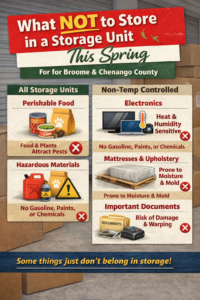
 What NOT to Store in a Storage Unit This Spring
A Local Guide for Broome & Chenango County
Spring is one of the busiest times of year for storage in Upstate New York. Between cleanouts, moves, renovations, and downsizing, many people rent a storage unit quickly — without always thinking about what actually belongs in storage.
While storage units are incredibly useful, not everything should be stored, especially during spring in Broome County and Chenango County, where moisture, temperature swings, and seasonal pests are common.
This local guide explains what not to store in a storage unit, why it matters, and how to avoid costly mistakes.
Why Spring Storage Is Different in Broome & Chenango County
Spring in the Southern Tier isn’t just warmer weather — it also brings:
-
Snowmelt and excess moisture
-
Rapid temperature changes
-
Increased humidity
-
Rodents and insects becoming active
At Laing Self Storage, we see the same spring-related storage issues every year across Binghamton, Endwell, Endicott, Conklin, Greene, and Lisle.
Many storage problems aren’t caused by the unit itself — they’re caused by storing the wrong items under the wrong conditions.
Items You Should NOT Store in Any Storage Unit
Perishable Food or Pantry Items
Food of any kind should never be stored in a unit.
Why:
-
Attracts rodents and insects
-
Can spoil quickly during spring temperature swings
-
Creates odors that affect nearby units
This includes canned goods, pet food, and boxed pantry items.
Plants or Organic Materials
Live plants, soil, mulch, or firewood do not belong in storage.
Why:
-
Plants won’t survive without light and airflow
-
Soil and wood attract moisture and pests
-
Organic materials can spread mold
Spring humidity in Broome and Chenango County makes this especially risky.
Flammable or Hazardous Materials
Do not store:
-
Gasoline or propane tanks
-
Paints, solvents, or chemicals
-
Fireworks or explosives
These items pose serious safety risks and are not permitted in storage facilities.
Items That Are Risky to Store Without Climate Control
Some items can be stored — but only under the right conditions.
Electronics
TVs, computers, and monitors are sensitive to:
-
Condensation
-
Temperature fluctuations
Without climate control, spring moisture can damage internal components.
Mattresses and Upholstered Furniture
Common spring mistake: placing mattresses directly on the floor.
Risks include:
-
Moisture absorption
-
Mold or mildew
-
Fabric deterioration
These items should be elevated, wrapped, and ideally stored in climate-controlled units.
Important Documents and Photos
Paper items are extremely vulnerable in spring.
Without climate control:
-
Humidity can cause warping or sticking
-
Ink can fade or bleed
-
Photos can permanently bond together
Items People Forget About — Until It’s Too Late
Appliances With Residual Water
Washers, refrigerators, and dehumidifiers often contain leftover water.
If not fully drained:
-
Mold can develop
-
Odors can form
-
Internal damage can occur
This is something we commonly see after spring move-outs.
Batteries and Power Tools
Batteries stored improperly can:
-
Corrode
-
Leak
-
Fail prematurely
Spring temperature swings accelerate this process.
How to Decide If an Item Is Safe to Store
Ask yourself:
-
Is it sensitive to moisture or temperature?
-
Would damage be expensive or irreversible?
-
Do I need access to it again soon?
-
Does it require climate control?
If the answer raises doubt, rethink how — or whether — it should be stored.
Local Storage Tip for the Southern Tier
In Broome County and Chenango County, spring storage works best when you:
-
Use climate-controlled units for sensitive items
-
Elevate belongings off concrete floors
-
Leave airflow gaps
-
Avoid storing anything organic or perishable
Most spring storage issues are preventable with the right preparation.
Frequently Asked Questions
What should never be stored in a storage unit?
Food, plants, hazardous materials, flammable items, and live animals should never be stored.
Can I store electronics in a storage unit?
Yes, but climate-controlled storage is strongly recommended, especially during spring in Upstate New York.
Is it safe to store furniture in spring?
It can be, as long as furniture is protected, elevated, and stored with airflow — ideally in climate-controlled units.
Why does spring moisture matter for storage?
Snowmelt and humidity increase moisture levels, which can lead to mold, mildew, and damage to sensitive items.
Final Thought
Storage units are designed to protect belongings — but only when the right items are stored the right way.
Understanding what not to store is just as important as choosing the right unit size or location.
Spring storage in Broome and Chenango County doesn’t have to be risky — it just has to be informed.